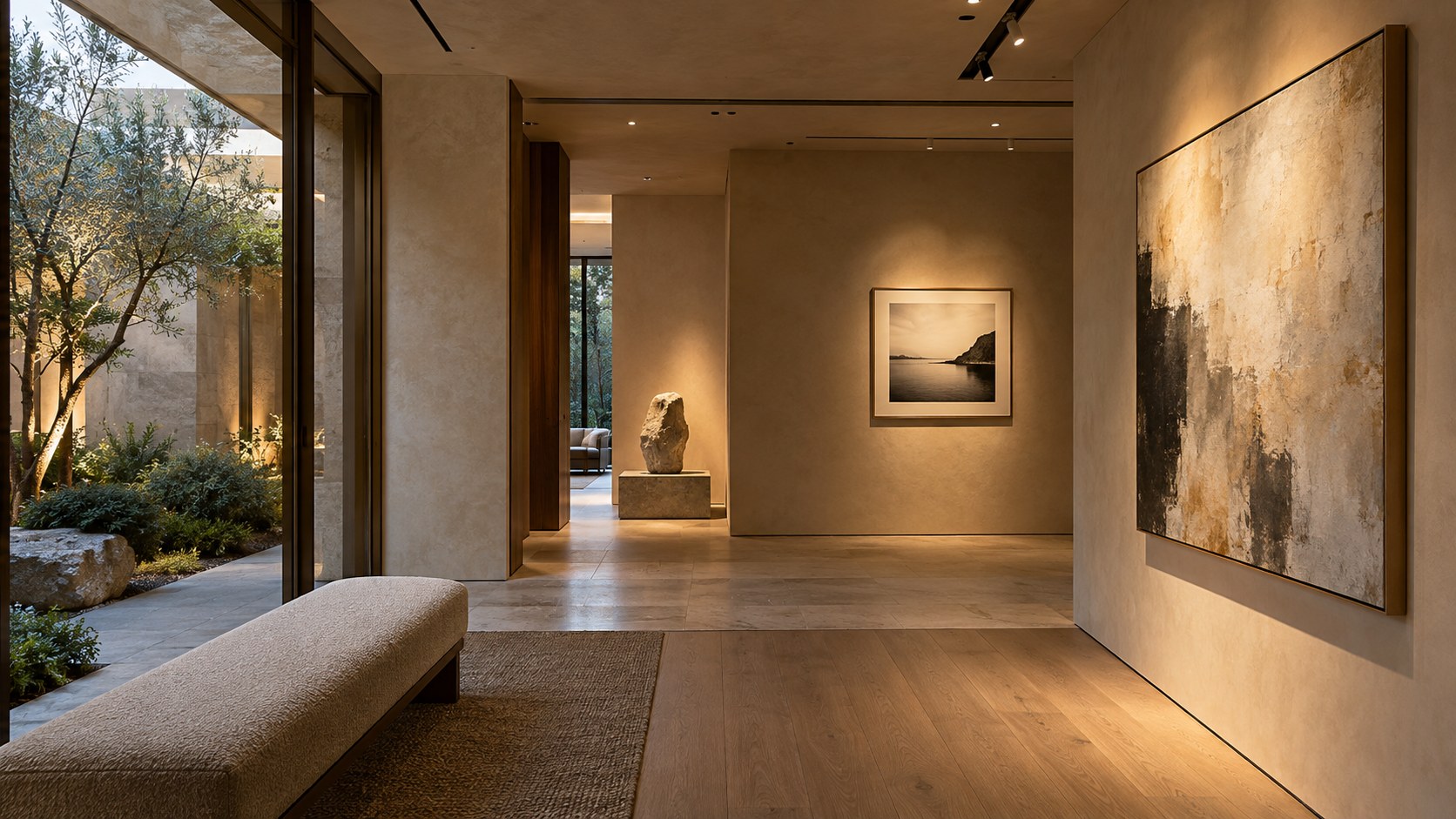
Art lighting begins with how a room is occupied and how a work is seen. From focused accents and wall washing to daylight, reflections, and material sensitivity, this essay explores the architectural decisions that make residential collections compelling, adaptable, and comfortable without sacrificing the everyday life of the home.
A painting does not occupy a wall in isolation. It is encountered from a doorway, glimpsed across a table, approached along a passage, and seen again under the altered conditions of evening. Its colors and surfaces respond to the light it receives, but so do the surrounding plaster, glass, timber, and stone. In a residence, the problem of art lighting is therefore architectural before it is decorative: what should the visitor notice, from where, against which background, and under what range of conditions?
This question becomes more demanding when the art belongs to rooms that must also support ordinary life. A dining room cannot remain a museum-like dark chamber while people eat. A gallery corridor must be safe and readable when no one is deliberately looking at a picture. A sculptural object needs physical room around it, not merely a dramatic spotlight. Daylight may enrich the experience while also introducing glare and cumulative exposure that matter differently to different works. The final composition has to serve viewing, living, and stewardship simultaneously.
A convincing design starts with a map of surfaces and human movement, then develops sightlines, openings, ceiling geometry, contrast, controls, and practical access as one coordinated system. The aim is not to make every object bright. It is to make attention intentional, reflections manageable, and the changing character of art perceptible without allowing illumination itself to become the dominant spectacle. These principles apply equally to modest collections and to ambitious conceptual residences: elegance emerges from the relationships between works, rooms, and the people who inhabit them.
Begin With the Viewer, Not the Fixture
A room may contain an exquisite painting and still fail to offer a satisfying view of it. The first task is to establish where a person is likely to stand, sit, and move. A picture above a sofa is usually seen from farther away than a small work in a corridor. A sculpture opposite an entrance may be experienced initially as a silhouette, before its details become legible at closer range. These situations produce different demands on the surrounding architecture. A fixed beam direction cannot be chosen thoughtfully until the positions of the eyes and the likely direction of approach are understood.
In an entrance hall, an artwork might be one of several competing visual destinations: the stair, a garden beyond glazing, and a doorway into a living room. A carefully placed light can give the artwork presence without interrupting the hall's primary purpose of orientation. If the work is hung at the end of a long axis, the surrounding brightness and the apparent scale of the wall may be more decisive than intense illumination. If it is viewed obliquely as people turn a corner, the treatment must remain comfortable across changing angles, not just from the perfect camera position.
Seated viewing adds another layer. From a low chair, a source hidden from a standing person may come into direct view, while reflections in framed glass can shift into the center of an image. The height of the artwork, its relationship to the furniture, and the inclination of a nearby glazing plane should therefore be studied from ordinary eye positions. These observations can influence where a partition is placed, how high a sofa back is allowed to rise, or whether the artwork belongs on another wall altogether. Lighting sometimes reveals a planning mistake that cannot be repaired by changing lamps.
Conceptual design benefits from sketching a sequence of encounters rather than a single frontal elevation. Consider the first glimpse, the comfortable stopping position, the closest inspection point, and the departure view. Where does the artwork command attention, and where should it relinquish that attention to circulation or landscape? Once those questions have architectural answers, a lighting approach can reinforce them with restraint. A successful composition is not one in which a work is constantly emphasized; it is one in which the work becomes accessible at the right moments.
Viewing Distance, Angle, and the Geometry of Attention
Viewing distance determines how the contents of an artwork become legible. Broad gestures or large tonal fields can read from across a room, whereas delicate marks invite a more intimate encounter. The architect need not prescribe a single correct distance, but must make plausible viewing positions available. A painting facing a narrow passage may leave little room to step back. A sculpture stranded in the middle of a circulation route may appear impressive in an empty rendering but create conflict whenever the house is occupied. Space around art is not wasted area; it is part of its perceptual setting.
The angle of approach is equally important. An image seen from the side becomes visually compressed, and reflective framing can pick up brightness from unexpected parts of the room. A clear frontal position need not sit exactly on a formal architectural axis. Sometimes a slight change in corridor width, a quiet alcove, or a bench placed opposite the wall permits a more relaxed encounter. The goal is not to force everyone to pause, but to make pausing possible without impeding people who are passing through. This distinction gives residential galleries a domestic generosity absent from some narrowly choreographed display spaces.
Sightline analysis should include interruptions at several scales. A door leaf may temporarily obscure a painting. A chandelier may cross its upper edge from the dining table. A glazed balustrade may reproduce its reflection. A textured wall return may form a stronger visual line than the artwork itself. These conditions cannot be evaluated by measuring only the artwork and the light source. The entire depth of the room, including furniture and architectural edges, participates in the image perceived by the visitor.
There is also a difference between an artwork's visual center and the geometric center of the wall. A tall, narrow composition may benefit from an asymmetric position relative to a doorway or an adjacent chair. A cluster of smaller works forms a field with its own rhythm, and the lighting can respond to that field rather than treating each frame as an independent target. By working from viewing positions to wall arrangement and only then to illumination, a design avoids a common error: technically well-aimed light applied to an unresolved display composition.
Focused Accents: Precision Without Theatrical Isolation
A focused accent can establish the visual importance of a single painting, photograph, or object. It offers control over where the light falls and how much of the neighboring wall remains quiet. But concentration is not necessarily refinement. An excessively tight pool of brightness can isolate a work from the architecture, exaggerate any irregularity in aim, and create a harsh boundary that competes with the picture's own edge. The most useful accent often has a gentle transition, allowing the surrounding surface to remain part of the viewing experience.
Beam placement must respond to the size and orientation of the work, the available mounting distance, and the people likely to occupy the space. A light positioned where it is hidden from one vantage may cause glare from another. A recessed fixture in a low ceiling can cast an unwanted shadow from the top of a thick frame; a distant source may illuminate the picture more evenly but introduce spill onto nearby furniture. These tradeoffs belong in the architectural section. Ceiling depth, recess geometry, wall height, and permissible aiming positions should be studied together rather than decided by an arbitrary row of downlights.
Focused illumination is particularly effective where a room contains one clearly privileged work. Imagine a restrained plaster hall with a single medium-scale painting and a dark bronze door at one end. A controlled accent may allow the painting to establish a moment of pause without washing the entire wall to the same brightness. In a richly furnished sitting room, however, isolating one picture too forcefully can make the rest of the room feel unconsidered. The same strategy must be adjusted to its setting. Intensity should support the artwork's relationship to furniture, material, and movement, not erase those relationships.
Good accent lighting also anticipates change. If the picture is rehung or replaced with a differently proportioned work, a rigid fixture position may no longer be useful. Concealed flexibility in aim and controls can preserve the calm visual expression of the ceiling while allowing the display to evolve. This does not imply that every room requires exposed gallery tracks. It means the underlying architectural infrastructure should be selected with a realistic understanding of how permanent the particular hanging arrangement is likely to be. Precision is most valuable when it remains usable.
Wall Washing: The Art of Illuminating a Field
Wall washing offers a different interpretation of the art wall. Rather than highlighting one isolated piece, it illuminates a larger vertical plane, potentially supporting several works and giving the surrounding architecture an even, legible presence. This approach can suit a corridor of photographs, an evolving group of prints, or a living room where art is integrated into a broad plaster composition. Its success depends on uniformity considered as an architectural effect, not as an absolute measure. A wall can be calm without looking perfectly identical at every point.
The distance between light sources and the wall, the mounting height, and the geometry of the ceiling determine whether illumination descends in a continuous field or breaks into visible scallops. If the upper wall receives a bright band while the bottom remains unnaturally dark, the spatial reading can become top-heavy. Conversely, light that flattens every shadow may remove the texture and depth that make a material wall interesting. The designer must decide whether the priority is reliable viewing of two-dimensional works, a sense of spatial expansion, or the revelation of a tactile surface. One arrangement rarely performs all three tasks equally.
A washed wall changes the perceived proportions of the room. In a narrow passage, a luminous long side can create a feeling of width and help maintain orientation. In a high gallery, an illuminated vertical field may draw the eye upward and make the wall itself feel monumental. These benefits can become drawbacks if the illuminated plane overwhelms the quieter wall opposite or if the luminance competes with daylight at the passage's end. Relative brightness matters as much as the number of fittings concealed in the ceiling.
When several artworks share a wall, their frames, sizes, reflectance, and hanging heights may differ markedly. A continuous wash accommodates variation in position but does not guarantee equal perceived emphasis: a pale photograph and a dark painting can respond differently to the same field. Thoughtful hanging order and control of adjacent illumination remain necessary. The architecture should allow the wall to act as a composed ensemble while accepting that each work has a distinct visual response. Wall washing is best understood as a flexible setting for art, not a substitute for inspecting the art itself.
Daylight: A Changing Partner With Conditions Attached
Daylight brings qualities that artificial illumination cannot reproduce simply by selecting a nominal color temperature. It changes direction, distribution, and intensity with the hour, weather, and season. A painting near a garden-facing window may feel animated in a softly lit morning room and nearly unreadable against a brilliant exterior in the afternoon. This change can be valuable; it also makes careful planning essential. The question is not whether art should receive daylight, but how the openings and surrounding surfaces mediate its arrival.
A direct shaft of sunlight can produce sharp contrast, moving patches, and exposure that may be inappropriate for a sensitive work. A deep reveal, a sheltered gallery, a carefully located partition, or controlled screening can offer a less aggressive relationship. North-facing or otherwise subdued daylight may appear attractive in one climate, but orientation alone does not ensure stable conditions: reflected light, seasonal sun angles, and nearby surfaces also matter. The building must be read in its actual environmental context rather than governed by a simplistic rule about which façade is safest.
The visual consequence of a window often extends beyond the sunlight that physically touches an artwork. A large bright opening in the viewer's field can draw attention away from a darker picture. It can also appear as a reflection in glazed photographs, making the image difficult to see even when the picture receives adequate illumination. The architecture may respond by turning the artwork perpendicular to the principal glazing, placing an intermediate return wall, or introducing a measured visual transition between window and display zone. Such choices are more robust than attempting to overpower daylight with a brighter accent.
Daylight should also be understood as cumulative exposure for vulnerable materials, not merely a momentary lighting condition. Paper, textiles, photographs, dyes, and particular finishes can be affected differently. The proper limits and protective measures for valuable or sensitive objects require informed, work-specific advice. At the architectural level, the responsibility is to preserve options: provide controllable openings, avoid compulsory direct sun at prominent display locations, and make an alternative wall or lighting mode available. The most graceful result allows natural change without treating the artwork as an expendable part of the atmosphere.
Glare, Reflection, and the Invisible Obstacle
Glare is often a problem of relationships rather than a problem of excessive brightness in isolation. A small visible source against a dark wall may be uncomfortable even when the rest of the room feels dim. A large window can create a competing luminous field. A polished stone floor can redirect a pendant into the viewer's eyes. Art adds another layer because many works are protected by glass or have surfaces that reflect light selectively. A beautiful composition from one camera angle may become difficult to read when a person moves only a few steps.
Consider a framed photograph in a corridor opposite a window. From one approach, the photograph may be perfectly legible; from another, a bright rectangle of reflected sky can cover its central subject. Moving the electric light does not necessarily solve this. The frame's position, the angle of the glazed surface, the viewer's route, and the brightness of the opposite opening form one optical problem. Sometimes the sensible response is to adjust the hanging plane or reorganize the display wall. The design should test likely viewing positions before expensive details become fixed.
Glossy paintings and sculptural surfaces introduce more complex responses. A smooth varnish may reveal a bright source as a defined reflection, while an uneven surface scatters light in a less predictable pattern. A bronze sculpture can reflect small highlights that are expressive when controlled and distracting when multiplied. The architect should resist treating all reflections as defects. Some help reveal material and form. The critical distinction is between reflections that communicate the work's substance and reflections that conceal its content or fatigue the eye.
Shielding, aiming, background brightness, and surface orientation all contribute to comfort. A recessed lighting slot can keep the source outside ordinary sightlines, but only if the relevant positions are evaluated. Deeply shielding a fixture can sometimes reduce useful coverage or create hard-edged light, so the ceiling geometry must be coordinated with the intended beam. In a residence, there is no single stationary spectator. People approach from a doorway, sit, stand, and turn toward conversation. Glare control must be designed for this moving audience, using architectural geometry rather than relying solely on an immaculate final photograph.
Material Reflectance: The Wall Is Never Neutral
An artwork is seen against a material background, and the background changes the eye's interpretation of the work. A matte mineral plaster wall tends to scatter light more gently than a polished stone panel, yet even a pale plaster surface can appear excessively bright beside a dark painting. Warm timber introduces grain, variation, and a stronger visual rhythm. Deeply colored wall finishes may allow luminous details in an artwork to stand forward while making circulation feel more enclosed. None of these effects is intrinsically better. Each establishes a distinct relation between figure and ground.
Material reflectance should be considered in the full room, not only at the display wall. A bright limestone floor may lift the perceived ambient light around a sculpture, while a dark rug can visually anchor its plinth. Glazed partitions may repeat the image of a painting in unexpected positions. Bronze or lacquered cabinet faces can introduce points of brightness that compete with an artwork even if they are not directly illuminated. A designer who studies only the illuminated wall misses the exchange of light among all these surfaces. The room is an optical environment assembled from materials of different behavior.
Texture presents a particularly subtle choice. Light arriving obliquely across rough stone reveals relief through shadow, creating a vivid background that may overwhelm finely detailed art. A smoother plaster wall gives the work a quieter field, but an excessively even surface may feel impersonal in a domestic room. Material selection and direction of light can be adjusted together: a lively wall can remain comparatively subdued while a nearby artwork receives clearer emphasis. Or the surface itself can be treated as a principal architectural feature, with art located where its own visual character can survive that competition.
Color also deserves careful attention without reducing the design to a technical number. A light source affects how pigments, fabrics, frames, stone, and surrounding wood are perceived together. Warm-toned rooms can feel welcoming but may shift the relationships among colors in certain works; cooler light can produce a different impression without automatically making an image more faithful. There is no substitute for viewing actual finishes and representative artworks under the intended conditions. The strongest residential display rooms respect material character while preventing the room's palette from silently rewriting the artwork's hierarchy.
Paintings, Photographs, and Works Behind Glass
Two-dimensional art is often grouped under one lighting strategy, yet a painting, an unglazed print, and a photograph behind reflective glazing present different challenges. The painting may have brushwork that benefits from directional light, or a dark, glossy surface that makes highlights intrusive. A photograph may depend on delicate tonal gradations that disappear when surrounding brightness is poorly balanced. A work under glazing can reflect the room independently of the image beneath. Architectural lighting should respond to these qualities without assuming that one beam position will suit every frame.
Scale further complicates the comparison. A large painting may occupy enough wall area to participate in the composition of the room, while several small photographs require a different rhythm of looking. The former invites a broad encounter; the latter often asks the viewer to approach and inspect. A single theatrical accent over each small frame can make the wall feel fragmented, whereas a calmer shared field may preserve the relationship of the group. Conversely, a major solitary painting may benefit from a more specific emphasis than the wall around it. The decision depends on display intent, not a general preference for spotlighting or washing.
The frame is part of the architecture of viewing. A deep moulding can cast a shadow onto a work if the light arrives at an unfavorable angle. A polished frame can become a bright border competing with the image. A projecting mount or shadow box introduces real depth into what initially appears to be a flat surface. These conditions should be considered when establishing the wall location, mounting height, and ceiling-light relationship. If a collection changes, the system needs enough adjustment to accommodate new frame depths and proportions without reconstructing the room.
Sensitivity and value call for another kind of restraint. A visually successful installation is not automatically appropriate for prolonged exposure. Different media and particular works can have different vulnerabilities to light and environmental conditions. The architect should avoid supplying universal exposure promises, which belong to informed assessment of the objects themselves. What architecture can do is provide low-exposure modes, controllable daylight, a choice of display positions, and electrical infrastructure that allows a conservator or collection specialist's recommendations to be implemented later. In a home, the most valuable treatment may be the ability to enjoy a work attentively for limited periods rather than illuminating it conspicuously throughout every hour.
Sculpture: Lighting a Volume and the Space Around It
Sculpture occupies depth and often asks the viewer to move. Its lighting cannot be understood as a picture-shaped patch on a wall. Form emerges through the relation of light to curved, faceted, porous, or translucent surfaces, and through the shadows cast onto the ground and adjacent architecture. A single strong direction can give a powerful reading of mass while losing information in shadow. Several competing directions may reveal more surfaces but flatten the object into a collection of highlights. The design requires a considered hierarchy of illumination rather than an attempt to make every side equally bright.
The surrounding space matters as much as the object. A sculpture placed near a door must allow people to pass without accidental contact. An object on a plinth should be seen with its base and the floor beneath, so it does not appear to float unintentionally. A work within a recessed alcove may become intimate, but the enclosure can limit how much of its profile is visible. A freestanding object at the center of a gallery gains multiple viewpoints at the cost of greater spatial demand. These are decisions about circulation, enclosure, and architectural proportion before they become decisions about beams.
Material response may be dramatic. Matte clay, dark stone, reflective bronze, carved timber, and clear glass do not reveal form under identical conditions. A grazing direction can bring relief to a rough surface, but on glossy metal the same position may create a sharp reflection. Translucent materials may produce compelling effects when light passes through them, yet their mounting, glare, and background remain part of the design. The aim is to reveal the work's intended experience without turning the surrounding room into an exhibition of uncontrolled highlights.
Sculpture should also belong to daily life. A family might walk past it repeatedly without stopping; visitors may approach slowly from more than one side. A narrow beam that is effective for a frontal photograph may leave the reverse path uncomfortable or visually dull. Rather than overloading the object with sources, the architect can use a controlled balance between ambient orientation and deliberate form-giving accents. The work retains mystery, while its position and physical presence remain clear. This is particularly important in residential architecture, where sculpture should enrich movement through a home rather than become an obstacle within it.
Ceiling Geometry and the Hidden Infrastructure of Choice
Art lighting makes demands on the ceiling that are easy to disguise in an image and difficult to ignore in a building. Light sources need appropriate positions, power, control, adjustment access, and space around the actual assembly. A deep timber soffit may offer opportunities to conceal equipment, but its beams can also obstruct aiming and cast unwanted shadows. A thin plaster ceiling may look elegant while leaving inadequate depth for an intended recessed source. The architectural section must establish the relationship between ceiling planes, structural elements, art walls, and occupant viewpoints before a finished surface is drawn.
There is no universal ceiling expression for an art-focused residence. A discreet track can communicate flexibility and permit changing displays; an integrated slot can give a quieter visual field; a series of carefully positioned recesses can reinforce a regular architectural rhythm. Each brings a tradeoff. Highly fixed lighting locations may suit a permanent hanging scheme but limit future changes. Exposed adjustable systems offer adaptability yet can dominate a low or intimate room. Deeply hidden sources require exacting coordination and can become frustrating if their access or aiming range is underestimated. The proper strategy grows from the desired life of the space.
Coordination with ventilation, sprinklers where relevant, structure, curtain pockets, acoustic treatments, and decorative lighting is equally important. A downlight should not be shifted casually into a visually convenient position if a beam or duct prevents a plausible installation. Nor should a wall wash be specified without considering where the ceiling changes level, where a partition ends, or how the detail can be inspected. The result of poor coordination is often a ceiling crowded with exceptions: odd fixture spacing, visible patchwork, and services that compete with the artworks they were meant to support.
One useful method is to reserve lighting zones rather than pretending every eventual object is already known. A gallery wall can be assigned a coherent region of adjustable illumination, and a sculpture position can be given a credible field of potential light directions. The final choice can respond to an actual work without disturbing the architectural order. Such preparedness is not visual indecision. It is an acceptance that a residential collection may change while the building remains. An elegant ceiling is one that looks deliberate today and continues to accommodate deliberate decisions tomorrow.
Galleries and Circulation: Making Looking Part of Movement
A residential gallery rarely behaves exactly like a public exhibition room. It may be the passage between bedrooms, a link from entry to garden, or a landing around a stair. People use it repeatedly for destinations unrelated to art, often carrying objects or moving at different speeds. Lighting should therefore establish a comfortable route at the same time that it permits moments of concentrated viewing. If the display dominates every part of the passage, the corridor may feel like an inconvenient museum. If circulation receives all the attention, the collection becomes decorative wallpaper.
The architecture can create a rhythm between movement and pause. A widened bay opposite a work permits someone to stand aside. A bench set away from the main route offers a slower view without turning the circulation zone into a seating room. An artwork at the end of a passage can mark orientation, while smaller pieces along its length reward a more gradual encounter. The lighting may respond with a stronger visual destination, a quieter repeated wall field, and sufficient low-level illumination to keep corners and floor transitions intelligible. These distinctions should feel continuous rather than like disconnected installations.
Stair galleries add vertical complexity. Art on a tall wall may be seen first from below, then almost level with the eyes at a landing, and finally from above. One beam direction cannot necessarily serve these experiences with equal success. Glare from an upper fixture can be conspicuous during ascent, and a reflective artwork may capture a bright stairwell window. The relation of balustrades, treads, landings, and viewing positions should be studied in section. Even the choice of a transparent guard can change how light is reflected and where people pause to look.
The most persuasive circulation lighting establishes a sequence rather than a uniform treatment. A quieter entry may lead into a brighter gallery wall, then toward a softly illuminated garden at the end. The picture does not need to compete with every turning point; it can belong to a hierarchy of experiences. This approach also protects the domestic character of the home. Art becomes something encountered in the course of living, with places to stop and look when desired. The architectural achievement is a route that remains legible and gracious even when no one is studying the collection.
Living Rooms, Dining Rooms, and the Problem of Competing Activities
A painting over a sitting area shares the room with faces, lamps, television screens, windows, books, and the glow of a fire. The same space may function differently at breakfast, during an afternoon visit, and late at night. Unlike a dedicated gallery, it cannot be planned solely around one preferred view. The artwork's role must be balanced against conversation, reading, food preparation nearby, and the human need for a comfortable field of light. Emphasis on art is meaningful only when the other activities retain their dignity.
In a living room, it may be tempting to brighten an artwork until it commands attention from every seat. This can make the image appear detached from the furniture composition, as if it belonged to another room. A more nuanced hierarchy allows the wall and work to participate in the larger lighting scheme. A shaded lamp near the seating group can provide conversational warmth, while a controlled accent preserves enough contrast for the artwork to remain a presence. The surrounding plaster need not disappear into darkness, and the artwork need not be the brightest surface in every scene.
Dining rooms introduce particular challenges because decorative pendants and reflective table settings occupy the same view as wall-mounted art. A pendant may appear in the reflection of a glazed photograph, and a bright table may create a strong foreground competing with a delicate painting. This is not solved simply by dimming everything. The geometry of the pendant, the position of the art wall, the seated eye level, and the brightness of adjacent surfaces must work together. A dining room can be luminous and social while protecting a quieter background for viewing.
A home may also contain a work that deserves temporary prominence. During an evening gathering, an owner might choose to increase the light on one sculpture while lowering a nearby wall. At another time, the art can recede and the garden or conversation take priority. These changes should be gentle and intuitive rather than requiring a complicated sequence of technical decisions. The point of integrating art lighting into domestic rooms is not to maintain a fixed spectacle. It is to give the residence a coherent atmosphere in which objects and people can share attention.
Contrast, Adaptation, and the Experience After Dark
Contrast helps the eye distinguish a picture from its surroundings, but a strongly lit object in an otherwise black room can be tiring and theatrical. Human vision adapts to the brightness of the field in which it is looking. A visitor moving from a sunny terrace into a subdued gallery may initially perceive little detail, even if a painting is adequately lit for someone who has been indoors for an hour. Conversely, a person leaving a dark screening room can find a bright art wall abrupt. The building should manage these transitions through adjacent spaces and surfaces, not simply apply more light to the artwork.
Evening offers an opportunity to establish a hierarchy without daylight's competition. The designer can lower general brightness while retaining a measured illumination of important objects, but the circulation route should remain clearly usable. A softly visible floor edge, a warm wall field, and a restrained accent may achieve more than a constellation of decorative ceiling points. If every artwork is independently illuminated to maximum intensity, the home can become visually noisy despite being technically well lit. Darkness needs organization just as much as light does.
The relationship to the exterior remains relevant at night. Glazing that frames a beautiful garden by day can turn into a reflective surface after dark. A lit painting may appear duplicated in a large window, and a bright fixture behind the viewer may obscure the garden altogether. Selective exterior lighting and lower interior sources can sometimes preserve visual depth, but their positions should avoid intrusive spill and unnecessary brightness. A darker garden is not necessarily a lost view; carefully chosen points of light can provide orientation while preserving darkness for the landscape and its ecology.
A useful assessment asks what happens when individual layers are turned off. If the art lighting is reduced, does the room remain legible? If the pendant is dimmed, can a guest still see a sculpture clearly enough to avoid it? If the garden lighting is absent, do the art-wall reflections become more conspicuous? Testing alternate scenes exposes the true hierarchy of the room. The objective is a resilient visual composition, one that remains calm under several realistic conditions rather than existing only at a single photogenic setting.
Dimming, Flexible Collections, and Architectural Longevity
A residential collection is rarely motionless over decades. Works are acquired, moved, lent, conserved, or simply rotated because the household wants to experience a different arrangement. Lighting infrastructure that assumes one definitive hanging position may feel precise at first but become an architectural liability later. The goal of flexibility is not to make the ceiling endlessly adjustable in appearance. It is to create enough capacity for change while preserving the room's visual order and the practical limits of the building.
Dimming supports more than atmosphere. It enables different viewing modes and can reduce unnecessary exposure when sensitive artworks do not need to be highlighted. Separate control of an art wall, a decorative fixture, and nearby circulation lighting can prevent one activity from forcing excessive illumination elsewhere. However, complexity has costs: systems that require constant attention are unlikely to be used thoughtfully. Clear, understandable scenes and sensible defaults often serve a household better than a technically elaborate arrangement with no intuitive operation.
Adaptability should be anticipated at the level of wiring routes, accessible drivers or other service components, fixture positions, and the dimensions of potential display zones. A large artwork may be replaced by several smaller pieces, changing the preferred distribution of light. A sculpture may move from the entry to a gallery, requiring a different pattern of angles. A room initially designated as a gallery may become a library or lounge. If the architecture provides a stable framework of lighting zones and appropriate access, these changes can occur without spoiling a carefully finished ceiling or opening walls unnecessarily.
A useful discipline is to separate permanent infrastructure from temporary display decisions. The architecture establishes available locations, shielding, control groups, and the physical capacity for maintenance. The installation of particular artworks then determines the final distribution and aiming. This does not make the design generic. It allows precision to be renewed as the collection changes. The most enduring luxury is a home that remains responsive to the people and objects living within it, without repeated destructive intervention every time a wall receives a different picture.
Material Care, Service Access, and the Final On-Site Review
An art-focused interior is an environment for stewardship as well as display. Light affects appearance immediately, and accumulated exposure can matter over time for many media. The relationship is not reducible to a universal setting because materials, condition, framing, duration, and the work's significance vary. A designer should not promise that a visually pleasant illumination is safe for every collection. More responsible architecture makes it possible to regulate exposure, choose sheltered locations, and seek work-specific guidance where sensitivity or value warrants it.
Practical access should be as deliberately planned as beam placement. Sources require adjustment and eventual replacement; controls and associated components may need inspection. A high ceiling that makes artwork appear monumental can make routine aiming awkward or disruptive. A lighting slot that looks immaculate but cannot be maintained without damaging plaster is not a refined detail. The architect should account for accessible service routes and safe working positions without placing equipment directly in the center of the domestic experience. Durability is part of visual quality because neglected or misaligned light quickly changes the intended composition.
The final review must happen with real material samples and, where appropriate, representative works in the nearly completed space. Drawings can predict lines of sight, but they cannot fully substitute for seeing reflected windows in a frame or understanding how a textured stone floor changes perceived brightness. Review the installation from entrance, standing, seated, and moving positions. Examine the room with daylight strong, weak, and absent where practical. Look for sources directly visible at ordinary eye level, harsh shadows from frame depths, excessive spill, awkward control transitions, and uncomfortable differences between adjoining spaces.
A final commissioning conversation should also establish how the room will be used. Who can adjust the scenes? What happens when a photograph is moved? How will a sensitive work be protected during prolonged daylight? Which access panels must remain available? These questions join visual experience to long-term care. The point is not to burden domestic life with institutional procedure, but to make the architecture quietly competent. The best lighting scheme can be enjoyed without constant explanation and maintained without undermining the surfaces that give the home its character.
Architecture gives art its setting before a source of light is switched on. It determines the first glimpse from a doorway, the distance from a sofa, the shape of a recess, the texture of a wall, and the path by which a person approaches a sculpture. Lighting can strengthen these relationships or expose their weaknesses. A beam that is perfectly directed cannot restore a comfortable viewing distance that was never planned; a beautiful illuminated wall cannot remove reflections created by an ill-considered window position.
The most convincing residential art environments bring several forms of care into agreement. Focused accents and wall washing are chosen for different viewing tasks. Daylight is welcomed but mediated. Glare is evaluated from moving and seated positions. Ceiling infrastructure allows adjustment without becoming the dominant visual feature. Dimming supports daily life rather than theatrical display, and maintenance access prevents apparent simplicity from becoming fragile. Paintings, photographs, and sculpture each receive a setting suited to the way they are seen and the vulnerabilities they may carry.
For conceptual luxury architecture, these considerations offer an especially meaningful standard. A persuasive image can show an immaculate gallery, but a deeper design asks whether the works can be viewed comfortably, whether the glass will reflect the wrong window, whether the ceiling can accommodate actual fittings, and whether changing an artwork requires dismantling the room. Those questions do not diminish the imaginative freedom of architecture. They give it intellectual and practical weight.
Ultimately, art lighting is not the ambition to make a collection glow. It is the design of a relationship between attention, material, space, time, and human presence. When that relationship is well judged, the artwork remains itself, the home remains inhabitable, and the light becomes a quiet instrument of perception rather than a performance demanding notice.
AI disclosure: This Architecture Journal essay explores architectural and design principles through conceptual and AI-generated inspiration. It does not claim a real-world client, architect, address, or built project.